
Sleeping Pad vs Air Mattress for Car Camping
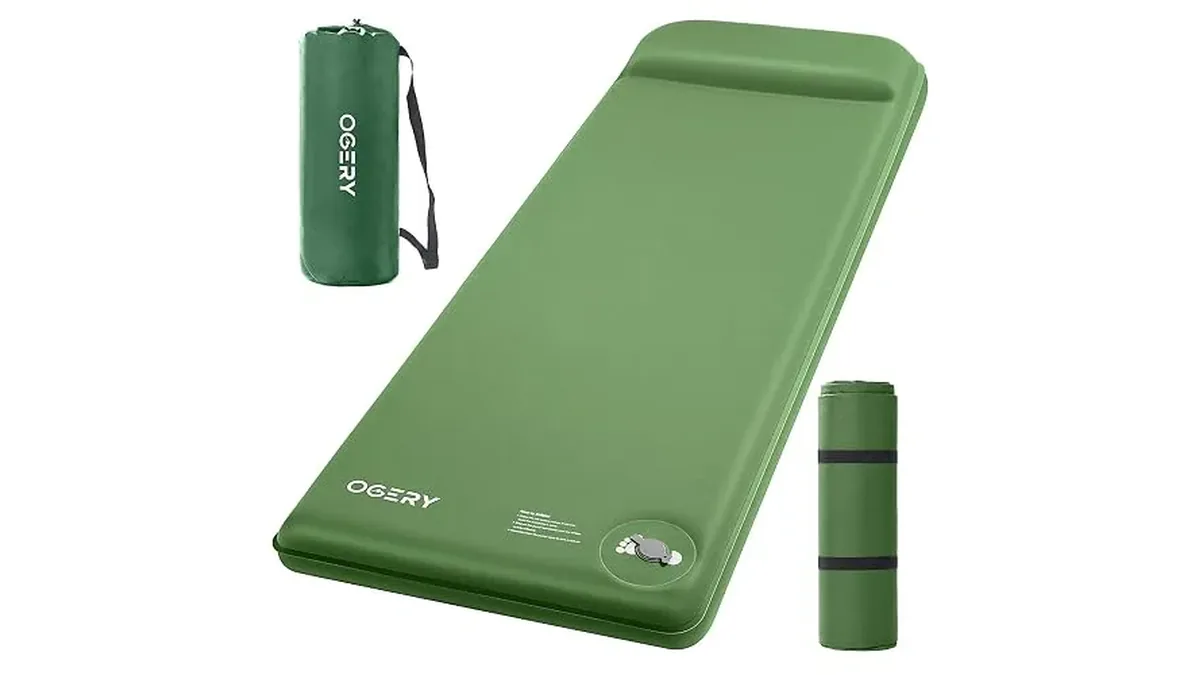
When you're driving to the campsite, space and weight stop mattering much, and an air mattress from home starts to look tempting. It's comfortable in the living room. In a tent at 3 a.m., it's often cold. Here's why, and when a camping pad is the better choice.
The big difference: warmth
An air mattress is a big bag of air. That air sits against the cold ground, cools down, and pulls heat out of you all night. That's why people wake up cold on an air mattress even in a warm sleeping bag. A sleeping pad is built to slow that heat loss, and its R-value tells you how well it does.
Foam is the simplest insulator. That's why OGERY's 3" Memory Foam Self-Inflating Pad is rated R-5 by OGERY's chart: the foam layer cuts heat loss to cold ground on cooler nights.
Side by side
| Household air mattress | Foam-and-air camping pad | |
|---|---|---|
| Warmth off cold ground | Low, no R-value given | Rated: R-5 for the 3", R-6.0 for the 3.15" |
| Feel | Bouncy; moves when your partner moves | Steady, quiet |
| Setup | Needs a pump, usually plug-in | Self-inflates; foot or built-in pump to finish |
| Leaks | Go flat overnight | Foam still gives some support |
| Packed size | Bulky | Rolls up; about 27.6 × 8 in (701 × 203 mm) for the 3" |
| Weight | Heavy | About 6 lb (2.7 kg) for the 3" |
Comfort, honestly
A tall air mattress feels more like a bed, especially if you sleep on your side and dislike thin pads. A thick foam pad gets close: the 3" pad lets you add air with its built-in foot pump until the firmness feels right, and the breathable fabric avoids the sweaty, plastic feel of an air-only mattress in summer. The 3.15" Foam Pad + Electric Pump is a step plusher, with a raised built-in pillow and a button that inflates and deflates it.
When an air mattress is fine
- Summer nights that stay warm
- Cabins and yurts with a raised floor
- Guests at home
If you do bring one, put a foam pad or a thick blanket underneath it. That layer does most of the insulating.
When to bring a pad
- Any night below about 50°F (10°C)
- Spring and autumn trips
- Tents pitched on bare ground
- Campsites where you don't want to rely on a plug-in pump
Getting the most from a self-inflating pad
On the first trip, give the foam a few minutes to expand by itself before topping it up. To pack, open the valve, kneel at the far end and roll toward the valve, then close it. At home, store it flat or loosely rolled with the valve open, so the foam keeps its spring.
All of OGERY's pads are compared in our sleeping pad comparison, and our R-value guide explains the numbers. Foam pads are in Self-Inflating Sleeping Mats.
Why car camping makes the air mattress tempting
When the car carries the gear, people reach for the tall household mattress because it feels like home. That comfort is real on a warm cabin floor. On bare ground under a tent fly, the missing R-value shows up as a cold back by early morning. A foam-and-air camping pad is built to slow that heat loss, and OGERY publishes R-5 on the 3" pad and R-6.0 on the 3.15" pad.
Choosing between OGERY's two thick pads
The 3" Memory Foam Self-Inflating Pad self-inflates, then finishes with a built-in foot pump so you can tune firmness. Packed size is about 27.6 × 8 in (701 × 203 mm) and weight is about 6 lb (2.7 kg). The 3.15" Foam Pad + Electric Pump is a step plusher, with a raised built-in pillow and a button that inflates and deflates it. Pick the 3" when you want a simpler foot-pump routine; pick the 3.15" when you want electric assist and the pillow built in.
Trip checklist
- Read the R-value against the coldest night on the forecast.
- On the first inflate, give foam time to open before you top it up.
- Pack by opening the valve, rolling toward the valve, then closing it.
- At home, store flat or loosely rolled with the valve open.
- If you still bring a household air mattress for warm cabin nights, put foam or a thick blanket under it.
All of OGERY's pads are compared in our sleeping pad comparison, and our R-value guide explains the numbers. Foam pads are in Self-Inflating Sleeping Mats.
Noise and partner sleep
Household air mattresses often squeak and shift when one person turns. Foam-and-air camping pads stay quieter because the foam damps movement. Couples in a shared tent usually notice that difference before they notice packed size. If one partner runs cold, the published R-value on the OGERY pads is the clearer planning number than mattress height alone.
Cabin versus tent decision
Warm cabin floors can still use a household air mattress for height. Cold tents need the foam-and-air stack and the published R-value. If the trip mixes both, bring the OGERY pad for tent nights and leave the tall mattress for the cabin. Do not expect mattress height alone to replace insulation numbers on the ground.