
How to Use the OGERY Backpack Sprayer, From Charging to Cleanup
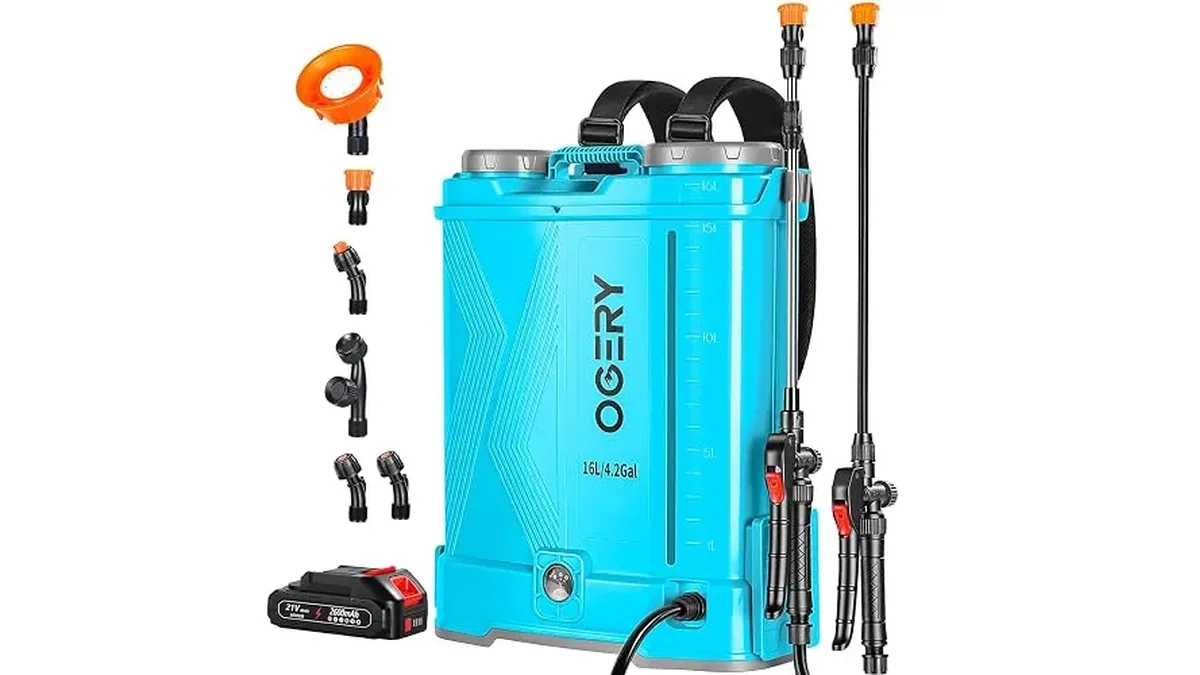
Prepare the liquid and choose the wand before filling the 4-Gallon Backpack Sprayer. Its battery pump removes hand pumping, but the tank label, nozzle pattern and cleanup still determine how the job should proceed. Start with a small, manageable load rather than assuming a full tank is necessary.
Check the job against both sets of instructions
Read the sprayer instructions and the label for the liquid you intend to apply. The equipment's ability to deliver a solution does not establish its suitability for a plant, surface or weather condition. Follow the liquid's directions for dilution, protective equipment, application and disposal. Do not use nozzle names as a substitute for those instructions.
Choose a work area and plan where you will stop, refill and rinse. Keep unrelated yard work separate so you do not leave a loaded sprayer unattended while changing tasks. If you also need to cut back growth, compare the Hedge Trimmers separately; spraying equipment does not solve access or pruning problems.
Charge before measuring the mix
OGERY rates the supplied 2.6Ah lithium battery for about 90 minutes of continuous spraying, with roughly 2.5 hours on the included fast charger. Those are equipment claims, not a promise that every filled tank or yard will be completed on one charge. Start with a charged pack so battery uncertainty does not interrupt a measured batch.
The sprayer has low-voltage shutoff. If it stops, check battery charge as part of diagnosis rather than immediately assuming a blockage. OGERY also lists compatibility with Makita 18V batteries. Confirm the specific battery against the sprayer instructions before planning to use an existing pack as a spare, and stop spraying before changing it.
Pick the wand for compatibility first
The telescopic stainless steel wand is described for water and neutral solutions. Extend it when reach is useful, and retract it when moving between work areas. Reach is a convenience, not a reason to select the metal wand for a liquid outside its stated use.
The plastic wand is described for diluted acids and alkalis in the pH 4–9 range. That range is not blanket approval for every chemical with that pH. Check the liquid and equipment instructions together. If compatibility is unclear, resolve it before filling rather than hoping a later rinse will undo exposure to an unsuitable mix.
Fill for the area you will actually treat
Despite the four-gallon product name, the stated tank capacity is 4.2 gallons or 16 L. Use the semi-translucent wall and gallon markings to track the fill level. Keep the filter screen in place while filling so debris does not enter with the mix. Measure the amount needed for the planned job according to the liquid's label.
A full load adds substantial weight: 16 L of water alone is about 35 lb, before the roughly 8 lb empty sprayer. Adjust the shoulder straps while the unit is empty and choose a fill amount you can manage. Avoid making the first trial a full-tank lift. Leftover solution also creates a disposal task, so excess capacity is not a reason to mix excess liquid.
Select a pattern, then inspect the result
OGERY supplies several nozzle choices. The single-head nozzle suits individual targets, the fan pattern covers a broader pass, and the stream nozzle offers reach. The F-type dual nozzle can be angled for rows. Choose the pattern for the target layout rather than selecting the one that appears to discharge fastest.
The windproof nozzle is intended to reduce drift; it does not make unsuitable wind conditions acceptable. Follow the application label's weather restrictions. Before treating the whole area, inspect the pattern in an appropriate test setup using clean water where permitted. Confirm that the chosen direction and coverage match what you intended, without exposing nearby plants or surfaces unnecessarily.
Adjust pressure without seeking maximum flow
The pressure knob changes output, and OGERY describes adjustment at the nozzle and handle switch as well. Its maximum listed flow is 3.1 L/min. That maximum is a capacity figure, not the correct setting for every job. A delicate target and a distant target need different approaches.
Make one adjustment at a time so you can see what changes the pattern. If coverage becomes uneven, pause and inspect the nozzle and filter according to the instructions rather than simply turning pressure up. The trigger lock can reduce continuous squeezing during a pass; release it before setting the wand down or interrupting the job.
Stop for an unexplained change in output
If the pattern suddenly weakens or becomes irregular, release the trigger and stop before adjusting anything. Check the battery state and remaining liquid, then inspect the filter and nozzle as the equipment instructions direct. Do not keep turning up pressure to compensate for a fault you have not identified. Never inspect a blocked nozzle by pointing it toward yourself.
After a correction, verify the pattern again before returning to the treatment area. If the problem repeats, note whether it occurs with a particular wand, nozzle or battery and use that information when seeking support. Do not assume every sudden stop is low voltage simply because the sprayer has that protection; an unresolved fault needs a different response from an ordinary recharge.
Finish the liquid path, not just the tank
Dispose of leftover mix as its label directs. Rinse the tank and run clean water through the pump and the wand used, following the product's cleaning instructions. Merely emptying the tank can leave solution elsewhere in the system. Check the filter screen while it is accessible.
Let the cleaned equipment dry before storage and prepare the battery according to its instructions. If the next job uses a different product, verify that the cleaning procedure is adequate before mixing it. Review the equipment options in Sprayers when you know the needed capacity and application, rather than buying by the largest tank alone.