
How to Stay Cool in a Tent, From Afternoon Pitch to Sunrise
Staying cool in a tent comes down to a run of small decisions across the day, and most of them happen hours before you lie down. The fabric soaks up sun all afternoon, the rainfly holds that warmth in, and your own body heat adds to it once you zip the door. Appalachian Outfitters describes it as a greenhouse effect that can carry on well into the night after the outside air has cooled.
So this plan follows the clock. Each stop is something to do at that point in the day, drawn from camping guides by Appalachian Outfitters and REI, heat safety advice from the National Weather Service, and the specs of OGERY's camping fan.
Mid-afternoon: choose shade that will still be there at 2 p.m.
Appalachian Outfitters puts site choice ahead of any piece of gear. Tree shade lowers the air temperature around the tent, and the benefit carries into the night. The catch is timing. A site that's shaded when you arrive in the morning may sit in full sun by 2 p.m., so look at where the sun will be during the hottest hours, not where it is now.
A few other site rules from the same guide:
- Higher ground usually catches more breeze than low spots.
- Valley floors can trap warm air after sunset.
- A lake or river nearby cools the air around it through evaporation.
While pitching: point the door into the wind
Before you stake a corner, work out which way the breeze is blowing. REI's tent setup advice is to face a door toward the wind in hot weather, and Appalachian Outfitters says even a modest breeze is far less useful if the door faces away from it.
Stake the tent out tight and tension the rainfly evenly. REI says a taut fly leaves more air space between the fly and the tent wall, and that gap is where air moves.
If you have a tarp, hang it well above the roof instead of on it. Appalachian Outfitters suggests at least 30 cm of clearance, so air can flow between tarp and tent, and says a reflective tarp turns away more sun than a standard blue one.
Late afternoon: open everything and decide on the rainfly
Open every door, window and vent the tent has. Appalachian Outfitters recommends using low and high openings together. Cooler air comes in at the bottom, warm air leaves at the top, and that keeps air moving even when the wind drops.
Then check the forecast. On a night with no rain expected, Appalachian Outfitters suggests taking the rainfly off altogether, because it's the main heat trap on most three-season tents. If you'd rather keep it on, REI's advice is to roll up the fly doors and open its vents, and only close them if rain actually starts.
Sunset to an hour after: cool yourself before the tent
How warm you are when you get in sets the tone for the night. Appalachian Outfitters suggests:
- A swim, a cold shower, or a wet cloth on your wrists, neck and forehead before bed.
- Waiting until 30 to 60 minutes after sunset to get in, once the tent has had time to shed the day's heat.
- Swapping the sleeping bag for a light sheet or liner. In humid weather, a moisture-wicking fabric beats cotton.
Your sleeping pad matters too. The same guide notes that a thick, insulating pad traps body heat between you and the ground, and suggests a cot or a thinner pad with a lower R-value. Our sleeping pad R-value guide explains why a high R-value isn't needed on hot nights, and OGERY Foam & Inflating Sleep Pads lists the thinner options.
Bedtime: set the fan up to move air through, not around
On a still, humid night, open mesh alone won't do much. That's when Appalachian Outfitters reaches for a battery fan, and REI suggests one for sensitive sleepers too.
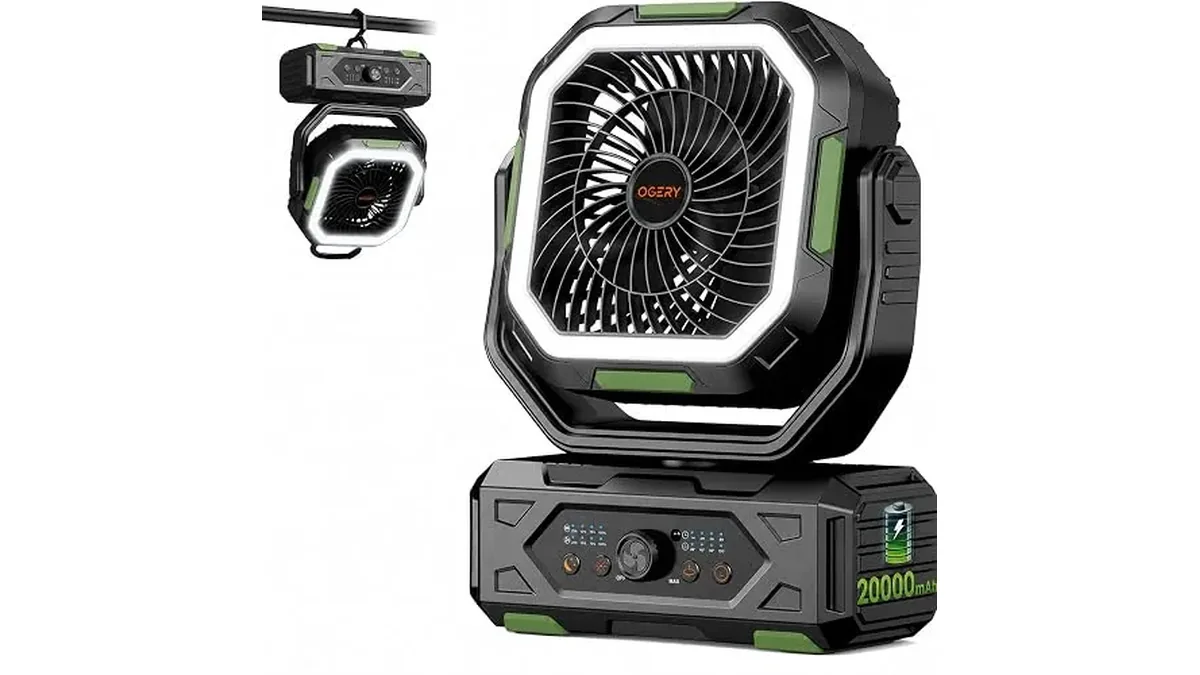
Placement makes the difference. Appalachian Outfitters suggests one fan pulling warm air out through a high vent and, if you have a second, another at a low opening pushing outside air in. It says that push-and-pull setup works better than one fan circulating the air already inside. It also suggests hanging a fan from the roof lamp loop to spread the airflow over the whole sleeping area, so check whether your fan can hang.
The OGERY Camping Fan, 20000mAh is sold for tent, travel and car camping. OGERY lists stepless speed control and a remote on matching versions, so you can turn it down from your sleeping bag, plus a built-in LED lantern for tent light.
Around 2 a.m.: when it's still too warm
If you wake up hot, a few things to try:
- Turn the fan down rather than up if it's going to run till morning. OGERY rates the 20000mAh battery at about 17 hours on the highest speed and up to 200 hours on the lowest. With oscillation on, the range is 14 to 35 hours.
- Try a homemade ice fan. Appalachian Outfitters suggests putting a frozen water jug in front of the fan's intake so the air passes over it. It says the effect is modest, but on a borderline night a few degrees can be enough.
- Kick off the sheet and let the airflow reach your skin.
Our OGERY 20000mAh Camping Fan Review covers the differences between fan versions, since controls and stands vary by model.
When a fan isn't enough
There's a limit to what moving air can do. The National Weather Service warns that a fan blowing on someone can actually make them hotter once the heat index is above the 90s. On a night like that, cooling down with water and getting out of the heat matter more than airflow.
Know the signs of heat exhaustion. The National Weather Service lists heavy sweating, weakness or tiredness, cool, pale and clammy skin, a fast and weak pulse, muscle cramps, dizziness, nausea or vomiting, headache and fainting. Its first aid steps are to move the person somewhere cooler, loosen their clothing, apply cool wet cloths and offer sips of water. Get medical help right away if they vomit, or if symptoms get worse or last longer than an hour. Signs like confusion, slurred speech or hot, red skin can mean heat stroke, which is an emergency: call 911.
Sunrise: get out early and recharge
Morning sun heats a closed tent fast, so open it up as soon as you're awake. REI notes that the rainfly is rarely dry by morning, and good airflow is what keeps most of that moisture on the outside of the fly.
Then think about tonight. A fan that ran all night needs a top-up. The PD20W Fan Charging Adapter is OGERY's charger for its F6, F11 and F21 fans, made to refill them between nights at a campsite with power. Check your fan's model number first, because it doesn't fit other models and isn't included with the fan.
For more warm-weather gear, browse OGERY Camping Fans, or see how fans fit next to pads and lanterns in our OGERY review.